
Identifying Weed Types and Growth Habits
Taproot vs Fibrous Root Systems: Why It Matters for Removal
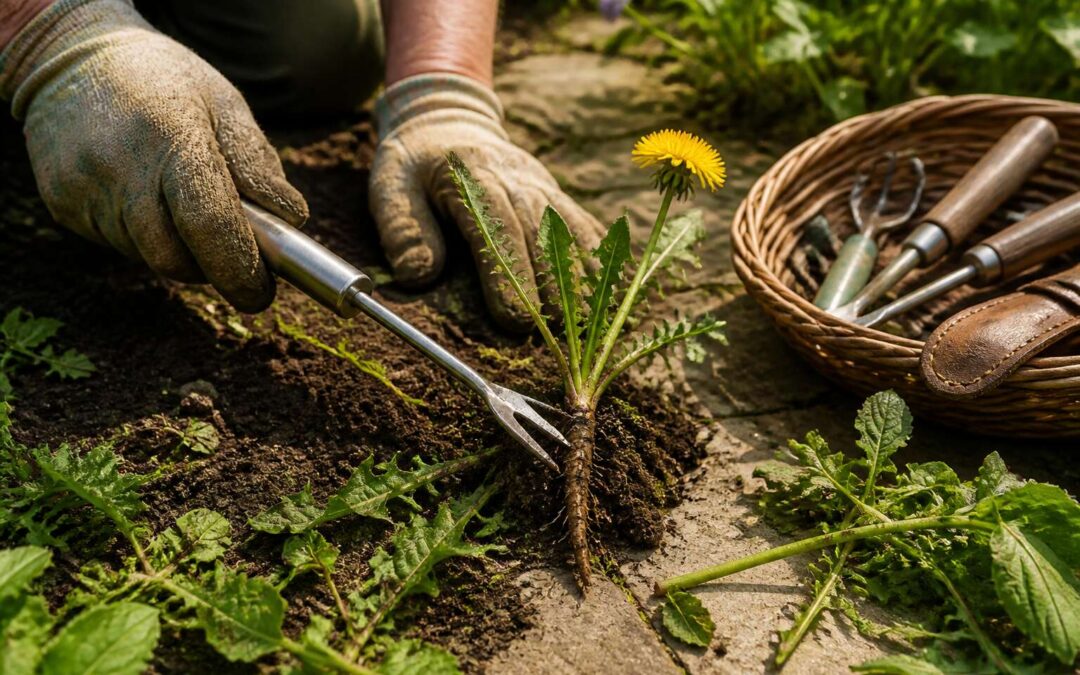
The difference between a taproot and a fibrous root system is not botanical trivia. It determines whether a weed dies with one clean pull or snaps off at the surface to regrow within days. A taproot, like on a dandelion, drives deep. Fibrous roots spread horizontally. Each demands a different tool.
Your choice of garden tools to remove weeds depends on these growth habits. Taproots need a long, narrow weeder that follows the root down. A hand fork or hoe lifts the fibrous network at once. The wrong tool leaves fragments behind, and every fragment becomes a new weed.
Common weeds fall into two groups:
- Taproot weeds such as dandelions, thistles, and dock that resprout from leftover root.
- Fibrous root weeds such as chickweed, clover, and kikuyu grass that cling to the soil.
Read the root structure before you dig. That habit makes garden tools to remove weeds more effective.
Annual Weeds That Spread by Seed
Each summer, one pigweed plant can drop 200,000 seeds into the soil. Annual weeds live fast, die, and leave their offspring waiting for the next rain. They germinate in disturbed ground, flower within weeks, and set seed before you notice the danger.
These weeds reproduce solely by seed, never by root fragments. Your garden tools to remove weeds only need to sever the plant above the soil. A sharp hoe works perfectly. The plant dies without a root system to depend on.
- Blackjack seeds hitch rides on clothing and pets.
- Khaki weed spreads through animal fur and wool.
- Purslane seeds survive decades in the soil.
Annual growth habits reveal themselves through quick germination and rapid flowering.
Perennial Weeds With Creeping Rhizomes
One fragment of nutgrass rhizome no longer than a thumbnail can found a new colony within a season. Snipping the visible leaves achieves nothing, because perennial weeds with creeping rhizomes store their energy in underground horizontal stems. Each node holds a dormant bud. The foliage above ground is only part of the network below.
Extraction demands a different approach from annual weeds. A digging fork lifts the root mass, but every broken piece roots again. The best garden tools to remove weeds for rhizomatous perennials loosen the soil first, so the entire tangle comes up intact. I have watched gardeners fight the same nutgrass patch for years!
South African soils harbour a familiar set of invaders:
- Nutgrass, whose tubers survive frost and drought
- Couch grass that spreads through raised beds
- Kikuyu that escapes the lawn boundary
Each node on these rhizomes regenerates, which is why garden tools to remove weeds from perennial beds must lift, never cut, the underground stems.
Recognizing Weed Growth Stages for Easier Extraction
Before you reach for your garden tools to remove weeds, read what the plant is telling you. A tiny seedling with two round leaves lifts out with barely a tug. The same species at flowering stage has already anchored itself with fine roots. Young weeds surrender quickly; old weeds resist.
Growth stage determines extraction ease. Look for the cotyledon leaves, those first mismatched pairs that differ from mature foliage. Rosette-forming weeds keep their leaves flat against the soil. A sharp hoe slid below the crown severs the plant from its root system. Wait until the flower stalk elongates, and the hoe bounces off tough fibres. Your garden tools to remove weeds perform best on young plants.
- Identify weeds when small, before the root deepens
- Distinguish annual from perennial habits at the seedling stage
- Water two hours before extraction; soft soil releases the whole plant
The best time to act is when the soil is moist but not saturated. Seedlings pulled then leave no fragments. Mature weeds often shatter at the crown, leaving root pieces behind. Experienced gardeners walk their beds after every rain, because that is when the extraction window opens.
Essential Hand Tools for Precision Weeding
Weeding Knives and Their Many Blade Shapes
A sharp blade can make the difference between a stubborn root and a clean pull. Weeding knives are essential garden tools to remove weeds with precision. Their blade shapes serve distinct purposes. The straight blade slices through compacted soil, while the curved blade hooks around taproots without damaging neighbours.
A pointed blade excels at probing crevices in paving or between stones. For delicate work, a narrow blade slips between seedlings. In my experience, among garden tools to remove weeds, blade shape matters more than the handle. Some knives have a forked tip for lifting creeping roots. Others have a serrated edge for fibrous material. Consider these options:
- Straight blades for cutting and slicing
- Curved blades for hooking and prying
- Pointed blades for crevices and tight spots
The right weeding knife transforms a tedious chore into a precise craft. Selecting the correct shape for the soil and weed type reduces effort.
Crack Weeding Tools for Pavers and Sidewalks
The most stubborn weeds hide in paver joints. Soil collects in the gaps, moisture follows, and a seed finds a home within millimetres of concrete. A broad hoe blade cannot fit, and pulling by hand leaves the root behind.
A crevice weeder features a thin, angled blade that follows the joint line. I find it slices the root crown cleanly, then you sweep the debris away. For deeper cracks, a hooked scraper works the root out without chipping the paver edge. A stiff wire brush removes the remaining soil and fragments. These garden tools to remove weeds belong in any pavement maintenance kit.
Useful items for crack weeding:
- Curved crevice weeder for joint lines
- Narrow scraper with a flat edge
- Wire brush for cleaning residue
Blade steel matters. High carbon steel holds an edge against gritty mortar, while stainless resists rust in coastal gardens.
Dandelion Pullers and Long Reach Extractors
A single dandelion can regrow from a root fragment less than a centimetre long. That is why the most effective garden tools to remove weeds are the ones that lift the entire taproot in one motion. A dandelion puller uses a split tip and a lever action. You press the tines into the soil beside the root, then pivot the handle backwards. The root comes up whole, no digging, no kneeling. Long reach extractors extend your reach to about a metre, saving your lower back while you work the same principle. Useful features include:
– A foot step for applying downward force
– A narrow slot to grip the root without crushing it
– A powder coated shaft for grip in wet conditions
Steel quality matters. Forged heads handle rocky South African soils better than cast ones. These garden tools to remove weeds earn their place in any serious toolkit.
Hand Forks and Cultivators for Loosening Soil
The narrowest gaps in a garden bed hold the toughest weeds. A hand fork reaches those spaces with precision. Its tines slide beside a taproot, not through it. As garden tools to remove weeds, hand forks and cultivators work differently. A cultivator breaks the soil surface in short, decisive pulls, dragging shallow root mats into the open air where they dehydrate and die.
South African garden soil tests every hand tool. Compacted laterite and rocky clay will bend a stamped steel fork in a single season. Forged heads endure. The cultivator handles the top few centimetres where annual weed seeds germinate, disrupting their hold before they establish.
- Forged, not stamped, steel heads
- Riveted handles that survive repeated hammering
- Tines roughly 10 centimetres long for deep root access
These garden tools to remove weeds operate at close range. They reward the gardener willing to crouch, observe, and methodically loosen the soil around each intruder. There is nothing fast about the work. But the result is a root fully exposed, with nowhere left to hide.
Ergonomic Grip Options to Prevent Hand Fatigue
A gardener’s hands take the brunt of weeding. Fifteen minutes with a poorly balanced handle leaves the forearm burning and the grip failing. Precision weeding demands tools that fit the palm, not fight it.
Ergonomic grip options have moved beyond basic rubber sleeves. The best handles feature contoured finger grooves, angled necks, and non-slip textures that hold even when hands are damp from the Highveld dew. Look for handles shaped to keep the wrist in neutral alignment. A bent wrist transfers strain up the entire arm.
Key features to check before you buy:
- Soft thermoplastic rubber that absorbs shock without slipping
- Hourglass profiles that match the natural curl of the fingers
- Short shafts for close work that keep the centre of gravity low
These garden tools to remove weeds should feel like an extension of the hand. When the grip is right, the tool disappears and the focus stays on the root.
Using Snips and Shears for Stubborn Stems
Some weeds refuse to yield to a simple tug. Thick stems, woody bases, and tangled growth demand sharper intervention. Snips and shears cut through what pullers cannot dislodge.
A sharp pair of bypass snips makes a clean cut at the stem’s base, stripping the plant of its top growth and slowing its energy supply. For thicker stems, shears with longer blades offer the leverage needed to slice through fibrous material.
Common snip types for stubborn stems:
- Bypass snips for clean cuts on live tissue
- Anvil snips for dry, woody stems
- Ratchet shears for extra cutting power
These garden tools to remove weeds earn their place when other methods fail. A precise cut at soil level stops many weeds from resprouting. The right snip ends the frustration quickly.
Stand-Up and Long-Handled Weeding Tools
Hoe Varieties: Draw Hoes, Scuffle Hoes, and Stirrup Hoes
Standing tall while weeding is a luxury, and the right long handled hoe makes it possible. The draw hoe pulls soil toward you, severing roots with a sharp, angled blade. Its cousin, the scuffle hoe, pushes and pulls in a slicing motion just below the surface, a technique that works well in loose beds.
For rocky or compacted South African soils, the stirrup hoe excels. It swings back and forth, cutting weeds at the root zone without disturbing nearby plants. When choosing garden tools to remove weeds, match the blade to the task:
- Draw hoes for deep, established weeds
- Scuffle hoes for shallow, frequent passes
- Stirrup hoes for tight spaces and stony ground
Each design minimizes effort, so you can work longer without bending. I prefer the stirrup for its smooth action, though the draw hoe offers more power for taproots. A well maintained edge is critical, as a dull blade crushes rather than slices.
Long-Handled Weeder with Stand-Up Design
Stand up weeding tools change the posture of the work entirely. Instead of kneeling or stooping, you engage the back and shoulders while keeping the spine neutral. The long handled weeder with stand up design places the working head at a fixed angle, so you can reach weeds between rows without stepping on the bed.
What separates a good model from a frustrating one is the fulcrum. A foot plate lets you press the blade into hard soil, and a curved shaft follows the natural arc of a swing. On compacted paths or lawn edges, these garden tools to remove weeds cut through stubborn roots without jarring your wrists.
I have found that pairing the right head with the right length matters more than the brand. The most effective garden tools to remove weeds are the ones you can use for an hour without noticing the handle digging into your palm.
Action Weeders with Trigger Mechanisms
Squeeze the trigger, and steel jaws close around the root below the surface. Action weeders with trigger mechanisms let you remove deep weeds without bending your back. The stand-up design keeps your spine neutral while the trigger provides the pulling force that your knees would otherwise supply.
These garden tools to remove weeds work best on taproots in firm ground. A quick squeeze lifts the root clear without disturbing neighboring plants. Some models have a depth stop to prevent over-penetration in loose beds.
Good models share these traits:
- Trigger tension matched to grip strength
- Jaws that close without gaps
- Shaft length suited to your height
The trigger gives a mechanical advantage that forearm strength alone cannot match. I reach for one in dry, compacted soil. For gardeners with limited mobility, these garden tools to remove weeds reduce strain on the wrists.
Root Slitters and Step Tools for Deep Taproots
Stand-up and long-handled weeding tools move the burden from your knees to your legs. Root slitters use a sharp blade to sever taproots below the surface. Step tools add a foot plate so you can press the head into hard soil with body weight.
I reach for these garden tools to remove weeds when the ground has baked solid. A step tool lets you drive the blade deep, then twist to cut the root clean. The shaft keeps your spine straight while you work.
- Foot plate wide enough for a firm boot
- Blade edges that hold sharpness
- Shaft length suited to your height
Root slitters excel on woody taproots like dandelions and thistles. Step tools handle compacted clay common in South African beds.
Adjustable Handles for Back-Friendly Gardening
Your spine deserves better than a short handle. Yet we spend hours bent at the waist, reaching for weeds that hug the soil. Adjustable handles change that equation.
When I choose garden tools to remove weeds, I look for a shaft that extends to match my height. Too short, and your spine curves. Too long, and you lose control. The adjustment mechanism must lock firmly. A wobbly joint does more harm than good.
- Aluminium shafts that are light but rigid
- Ergonomic grips that rotate as you swing
- Locking collars that withstand repeated pressure
The beauty of an adjustable handle is that it grows with the task. It becomes an extension of your height. You can shorten it for tight beds, lengthen it for open ground. Your back stays neutral, your knees stay unloaded, and the weeds still meet their end!
Powered and Automated Weed Removal Equipment
String Trimmers and Edgers for Surface-Level Weeds
Nothing clears a weedy boundary faster than a string trimmer at full throttle. Petrol models with monofilament line take down large infested borders in minutes, sparing your knees the drudgery of hand pulling. Edgers cut a clean line along pathways and lawn margins, stopping weeds from creeping into cultivated beds. Surface weeds die when you sever their top growth.
Timing matters! Run the trimmer before weeds set seed, and you reduce next season’s germination pressure substantially. For larger South African properties, I consider these powered units among the most practical garden tools to remove weeds when speed is the priority. They complement garden tools to remove weeds, covering terrain that hand pulling cannot match. Power source options include:
- Petrol models deliver more torque for thick grass and woody stems
- Battery powered units offer portability without fuel mixing
- Electric corded trimmers are lighter but tether you to a socket
Rotary Tillers for Large Garden Bed Renewal
One rotation of a tiller’s tines can unearth a season’s worth of rhizomes in minutes. That alone justifies adding a rotary tiller to your roster of garden tools to remove weeds. For a bed that has been overtaken by creeping perennials, this is the fastest way to start over.
Soil moisture determines success. Till wet ground and you produce bricks. Till dry ground and you produce dust. Aim for the narrow window where a handful of soil crumbles under gentle pressure. For large scale renewal, few garden tools to remove weeds match the tiller’s efficiency.
- Rent a rear tine tiller for compacted clay
- Use a front tine tiller for loose, sandy beds
- Pull out every exposed root fragment
Do not use a tiller near established plants. It has no sense of discretion.
Flame Weeding Torches and Heat-Based Tools
Flame weeding torches offer a distinct finality. A focused burst of propane raises the temperature inside the weed’s cells until the plant collapses. Heat based tools work best on young broadleaf weeds and annual grasses, within two weeks of germination. The heat ruptures cell walls and the plant dies within hours.
I have spent entire afternoons hand pulling weeds, only to watch them rebound within the week. Heat based tools hold an advantage over mechanical extraction because they leave soil structure untouched. No disturbance means no fresh weed seeds brought to the surface and no buried rhizomes cut into viable fragments. For gravel paths and paved areas, no other garden tools to remove weeds match their speed. Use a torch only when conditions suit it.
- Choose a calm morning with no wind
- Keep the flame moving and never linger in one spot
- Water the area first if the foliage is dry
Electric Weedless Gardeners for Patches
In one hour, an electric weedless gardener clears what takes me all morning by hand. The spinning head slices young weeds without churning the soil. I tested mine on a stubborn bed of purslane. It covered a square meter in under two minutes!
These garden tools to remove weeds perform best on loose, dry ground. Thick clay stalls the motor, and heavy moisture makes the blades clog. Charge time limits the total area. A single battery rarely finishes a full yard, so the work proceeds in bursts. The upfront cost is higher than manual tools, but the physical toll is lower.
Choosing Materials and Maintaining Your Weeding Arsenal
Stainless Steel vs Carbon Steel Blades
Stainless steel blades resist rust, which matters in Cape Town’s damp winters. Carbon steel takes a sharper edge and holds it longer, but it will corrode unless you wipe it down after every session. Some gardeners enjoy that ritual. Others just want to yank weeds and go inside.
The trade-offs matter when you are buying garden tools to remove weeds:
– Stainless steel: rust resistant, less frequent sharpening, softer edge
– Carbon steel: razor sharp, needs oiling, develops a patina
I keep a carbon steel hand fork for fibrous roots because it slices cleanly. My stainless steel long-handled weeder stays outdoors between uses because I am honest about my habits. Choose based on your tolerance for maintenance, not the marketing gloss.
Wooden vs Fiberglass vs Metal Handles
A handle is the first point of contact with your garden tools to remove weeds, yet most gardeners ignore it until it splinters! I have watched friends blame a wobbly head when the real failure was a cracked ash shaft.
Wooden handles flex and absorb shock, which suits repeated twisting motions. But they demand oiling and dry out in Cape Town’s summer heat. Fiberglass handles shrug off weather and stay light, though they transmit more vibration. Metal handles feel indestructible until they bend, and they turn freezing in winter mornings.
- Wood: natural grip, needs linseed oil every season
- Fiberglass: no maintenance, slightly rougher on hands
- Metal: strongest, but heavy and cold
I prefer fiberglass for long-handled tools because I leave them outside. The choice changes how your body feels after an hour of pulling weeds, and it also determines how long the tool lasts.
Sharpening Techniques for Weeding Tools
Sharpening transforms a dull weeder from a chore into a clean slice through soil. For garden tools to remove weeds, a keen edge matters more than the handle material. I use a diamond file on rigid blades, following the original bevel at a steady 20 degree angle. Three passes often revive a season of neglect! Serrated weeders need a round file threaded between teeth, then a light mineral oil wipe. Hoes on long handles appreciate a sharpened flat edge.
- Secure the tool firmly
- Stroke the file away from you
- Deburr with a wire brush
This ritual keeps every edge ready. The blade alloy determines how often you sharpen, not whether you should. Even premium materials dull in gritty Cape Flats soil.
Cleaning and Storage Habits to Extend Tool Life
Soil left on garden tools to remove weeds hardens in Cape Flats sun. A friend lost a perfectly good weeder to rust after one rainy season left it leaning against the wall. The blade alloy matters less than the habit you build after each session.
Here is my routine! Knock off loose dirt with a stiff brush. Rinse sparingly, because water accelerates corrosion on carbon steel. Dry completely, then wipe moving parts with a rag dipped in linseed oil. For wooden handles, sand away splinters before they become grip problems.
- Store tools off the ground, hanging or in a dry crate.
- Keep blades separated so they do not nick each other.
- Check joints and rivets twice a year.
Proper storage prevents most replacement purchases for garden tools to remove weeds. A designated spot also saves time when weeds reappear after the first good rain.
When to Replace vs Repair a Worn Weeding Tool
Material choices often dictate whether a worn tool becomes a repair project or a replacement purchase. For heavy clay soils, a thicker steel head resists bending. Lightweight alloys are easier on the wrists but may crack under levering pressure. Consider how a tool’s construction matches your ground conditions before you buy.
When a handle splits, replace it if the head still has life. Loose heads can be rewedged. However, a blade ground down to a sliver will never cut well again. Rust pits that compromise the edge also signal the end.
- Wobbly joints that cannot be tightened
- Cracks across the metal socket
- Bent shafts that throw off your swing
These failure points appear in garden tools to remove weeds after years of hard use. Sometimes a repair costs more than a new tool. Weigh the price of replacement parts against the remaining usefulness of the head.