
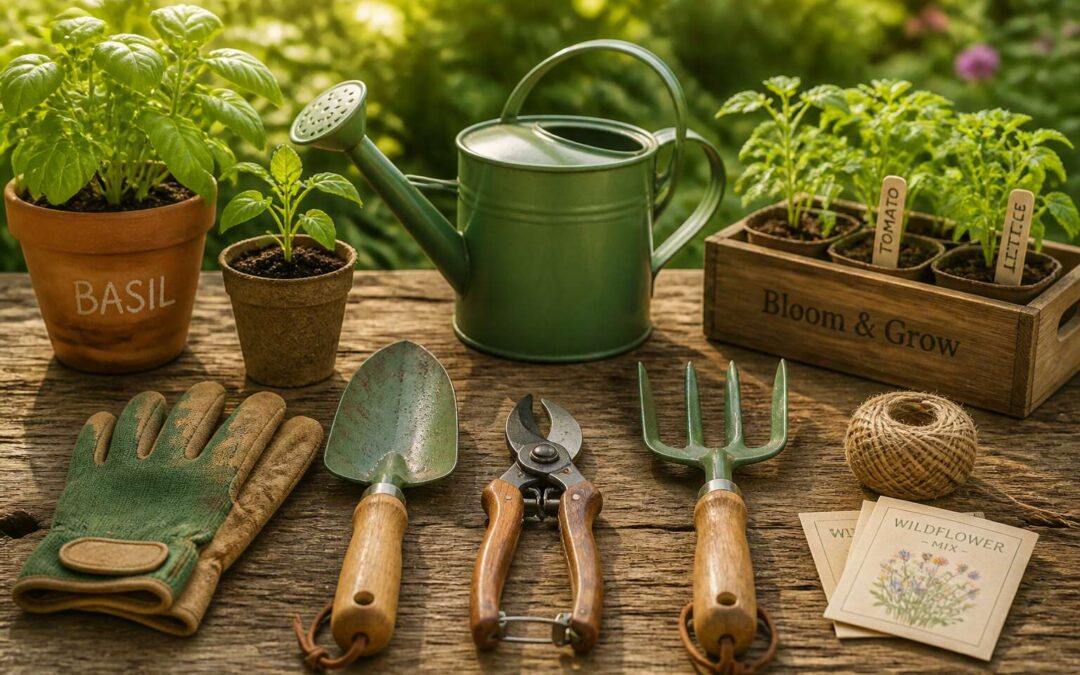
The Core Hand Tools Every Gardener Needs
There is a quiet dignity in a well worn hand tool, a loyalty that machines rarely earn. In South Africa, where the sun tests your patience and the earth rewards it, you learn quickly what you truly need. Any honest garden tools and equipment list starts with the same few companions.
- Hand trowel
- Pruning shears
- Garden fork
- Watering can
These four items handle the daily work of care. A trowel slips into compacted soil with gentle determination. Shears offer control where wild growth tries to take over. A fork opens the ground for air and water, and a watering can delivers life exactly where it belongs.
Power Equipment for Large-Scale Maintenance
Large-scale maintenance is a different animal altogether. The sheer size of the area forces a shift in mindset, moving away from precision hand tools and toward brute force and efficiency. The sound of a two-stroke engine idling becomes a familiar comfort, a promise that the workload won’t crush you by sunset. Your garden tools and equipment list must pivot entirely to accommodate this new reality.
You will find yourself relying on a robust roster of machinery that demands respect and regular care.
- Brushcutters with metal blades for thick scrub and alien vegetation.
- Chainsaws with varying bar lengths for felling and sectioning timber.
- Backpack blowers that can clear a football field of leaves in an hour.
- High-torque hedge trimmers for shaping dense, structural planting.
Daily use tests your resolve. The vibration settles into your bones, and the fuel mixture becomes a ritual. This is where the true cost of ownership emerges, not in the purchase price, but in the sharpening, the oiling, and the part replacements. A professional garden tools and equipment list is never static; it evolves with every breakdown and every new task, especially when tackling the heavy clay and tough grasses common to the South African landscape.
Essential Digging and Planting Gear
A garden begins underground, where the true work happens. The quality of your soil determines everything that follows, yet so many gardeners overlook the critical first step: proper soil preparation. Getting your hands into the earth with the right implements transforms this chore from a struggle into a ritual. You will find that the right tools make the difference between a weekend of frustration and a morning of quiet satisfaction.
Consider your garden tools and equipment list before you even purchase a single seedling. The absolute essentials for digging and planting are surprisingly few, but each one earns its place through sheer necessity. A sturdy spade with a sharp edge cuts through compacted ground with minimal effort, while a garden fork loosens stubborn clay without destroying its structure. For delicate work, nothing matches the precision of a hand trowel, especially when you are tucking in young seedlings or transplanting bulbs.
- A round-point shovel for general digging and moving soil
- A digging fork for breaking up hard ground
- A hand trowel for planting and transplanting
- A hori-hori knife for cutting through roots and soil
The secret to a comfortable gardening session lies in the handles. Long-handled tools reduce back strain, allowing you to work standing upright rather than hunched over. Meanwhile, shorter tools give you greater control when working in tight spaces or raised beds. If you are working with rocky South African soil, look for tools with reinforced heads and durable shafts. They will last for years if you treat them well.
Water is scarce in many regions, so planting strategies often focus on moisture retention. This means your choice of tools directly affects how effectively you can conserve water. A well-prepared planting hole captures rainfall efficiently, directing it straight to the root zone where it matters most. When you loosen the soil to the correct depth, you create a reservoir that sustains the plant during dry spells. The humble trowel becomes your ally in this ongoing dance with the elements.
Do not underestimate the value of a good pair of gloves, either. They protect your hands from blisters, thorns, and the myriad of hidden objects lurking in the soil. Beyond the basics, consider adding a transplanting spade to your collection if you plan to move established plants. Its narrow blade slips gracefully beneath root systems without causing unnecessary damage. Every tool in your garden tools and equipment list serves a purpose, and understanding that purpose elevates your gardening experience.
As the seasons change, so does the rhythm of your planting schedule. The tools remain constant, waiting patiently in the shed for their next moment of usefulness. When you choose quality over quantity, focusing on the essentials, you build a relationship with your garden that deepens with each passing year. The earth remembers your care, and your hands remember the familiar weight of well-loved tools.
Watering Systems and Irrigation Tools
Water is the lifeblood of any garden, yet delivering it efficiently is often where many well-intentioned projects stumble. In South Africa, where rainfall can be unpredictable and summer heat relentless, your choice of irrigation can mean the difference between a thriving oasis and a dusty patch of regret. Before you even consider the aesthetic appeal of your plot, you need a pragmatic strategy for hydration.
Start with the basics: a quality hose that doesn’t kink is non-negotiable. Pair it with a trigger nozzle to control pressure and save water. For deeper root systems, a soaker hose laid along the base of plants works quietly and effectively. The options extend to a focused list of tools that prevent waste and target specific needs:
– Drip irrigation kits for precise, slow watering.
– Oscillating sprinklers for rectangular lawn areas.
– Watering wands to reach hanging baskets with ease.
– Rain barrels to capture free, natural nourishment.
Choosing between these tools often comes down to understanding your garden’s specific layout. A sprawling vegetable patch benefits from the steady, underground saturation of a drip system, while a new lawn needs the broad coverage of a sprayer. This selection is a crucial part of any comprehensive garden tools and equipment list. Ultimately, the right equipment simplifies the chore, allowing you more time to enjoy the results instead of wrestling with inefficiency. When your watering system is correct, the entire garden responds with resilience.
Organization, Maintenance, and Safety Essentials
Let’s be honest, your shed is likely a disaster zone. It is a black hole where trowels go to vanish and extension cords tangle themselves into eldritch horrors overnight. An organised garden tools and equipment list is not just a spreadsheet for neat freaks, it is a survival mechanism. You spend less time digging for a spade and more time actually digging, which is the entire point. A simple pegboard or a wall-mounted rack turns chaos into a system you can navigate at 6am without swearing.
That being said, a tidy tool is a tool that lasts. Rust is the abrasive villain here, quietly pitting your precious metal between seasons. Get into the habit of wiping down blades after every use and giving them a light oil coat during the winter slumber. Wooden handles need love too; a quick sanding and a rub of linseed oil prevents splinters and keeps them from snapping at the worst possible moment. This simple husbandry extends the life of your gear considerably.
While you are busy curating your collection, remember the tools can bite back. A sharp edge is a safe edge, so keep your secateurs and shears keenly honed. There is no room for complacency when you are dealing with swinging blades and pointy tines.
– Always wear gloves to thwart blisters and lurking thorns.
– Store sharp implements with guards or facing downwards.
– Keep your first aid kit stocked and within reach.
You do not need a Ph.D. in physics to avoid stabbing yourself, just a modicum of common sense. Maintaining a proper garden tools and equipment list means knowing what you have and where it lives. It turns a chore into a pursuit, and honestly, it makes you feel like a professional instead of a glorified scavenger. The result is a safer, smoother session in the soil every single time.